


 Clear Cache





Centre for Materials Characterization (CMC)
Faculty in Charge:
Dr. Maneesh Chandran
Email id:
Mailing Address
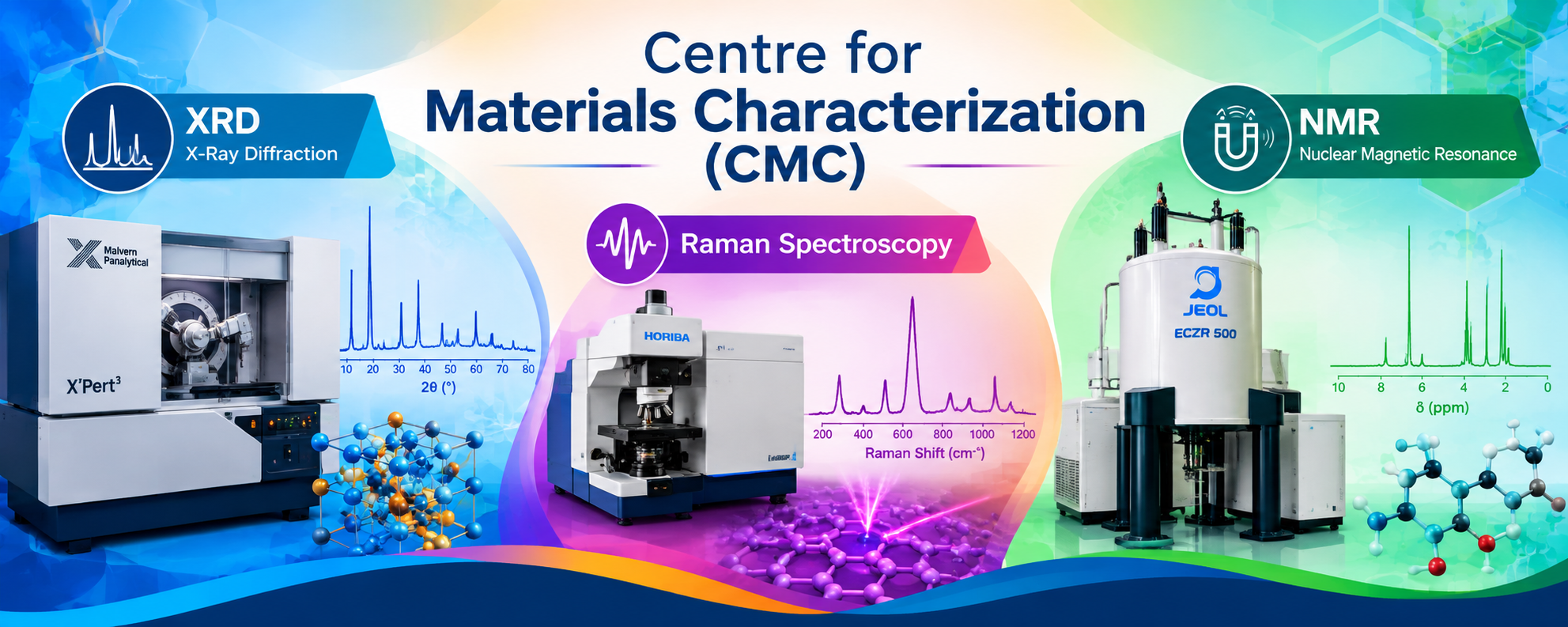
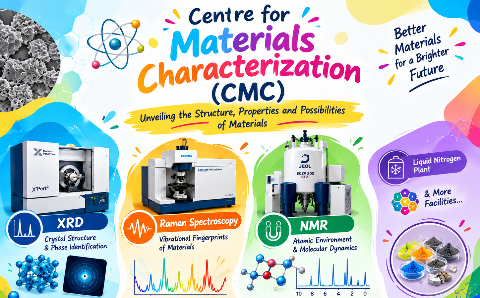
The Centre for Materials Characterization (CMC) at NIT Calicut is a premier research facility equipped with advanced instruments including X-ray Diffraction (XRD), Raman Spectroscopy, Vector Network Analyzer (VNA), Nuclear Magnetic Resonance (NMR), and a Liquid Nitrogen Plant. Serving as a multidisciplinary hub, the CMC supports cutting-edge research and academic activities across various domains of science and engineering. It provides essential infrastructure for precise material analysis, enabling both in-house and external researchers to conduct high-quality investigations. The Centre is committed to fostering innovation, collaboration, and technical excellence within the institute and beyond, and its facilities are open to the NIT community as well as other academic institutions, industries, and R&D laboratories.
- Click here for the CMC brochure ► CMC Brochure
Slot Booking Procedure for External Users (Outside NITC)
Step 1 – Login to I-STEM Portal & Slot Booking
Visit the I-STEM website and log in to your account.
Click here to log in to the I-STEM website 👉 https://www.istem.gov.in/
Search for the required equipment using the I-STEM equipment code given below then book your slot
1. Powder X-ray diffractometer (XRD) (I-STEM CODE- 3245637)
2. Confocal Raman Spectrometer (I-STEM CODE- 3245638)
3.500 MHz Nuclear Magnetic Resonance Spectrometer (I-STEM CODE- 3245640)
4. Liquid Nitrogen Generator (LN2) (I-STEM CODE- 3245641)
5. Vector Network Analysis (VNA) (I-STEM CODE- 3245639)
Step 2 – Download Requisition Form
After successfully booking the slot through I-STEM, download the Requisition Form from the CMC, NITC webpage and fill it out completely and accurately.
Step 3 – Payment Process
Make the payment using the QR code provided on the CMC, NITC webpage. After completing the payment, record the transaction details in the requisition form.
Step 4 – Sample Submission
Users may submit the sample in either of the following ways:
-
Visit NITC in person and hand over the sample, or
-
Send the sample by courier along with the completed requisition form to the corresponding address.
Note: The addresses for most equipment facilities are mentioned in the requisition form.
CMC - FACILITIES
1) Powder X-ray diffractometer (XRD) (I-STEM CODE- 3245637)
(Make : Malvern Panalytical, Country : Netherland, Model name: {PANalytical X'Pert3 powder}, voltage :45kV, current : 40mA, Radiation type: Cu K alpha, X-Ray Wavelength : 1.5406A)
👉 Click here to submit a request for an XRD GST INVOICE for External User(Outside NITC)
Slot Booking Link for Internal Users (Inside NITC) 👉 Click here to book your slot

2) Confocal Raman Spectrometer (I-STEM CODE- 3245638)
The Horiba LabRAM HR Evolution Raman Microscope enables high-resolution, non-destructive molecular and chemical analysis with advanced Raman and photoluminescence capabilities. Supporting multiple laser wavelengths (325, 532, and 785 nm), 3D imaging, and temperature-dependent measurements, it is ideal for materials science, semiconductors, pharmaceuticals, and life science research.

3) 500 MHz Nuclear Magnetic Resonance Spectrometer (I-STEM CODE- 3245640)
I-STEM Link for XRD Slot Booking (External Users(Outside NITC)) -
The JEOL ECZR Series 500 MHz NMR Spectrometer enables advanced structural and molecular analysis using solution and solid-state NMR techniques. Equipped with high-sensitivity probes and advanced software, it supports research in materials science, chemistry, pharmaceuticals, and biological sciences.

4) Liquid Nitrogen Generator (LN2) (I-STEM CODE- 3245641)
The LN2 Generator (LN40WC) provides an efficient on-site supply of high-quality liquid nitrogen with a production capacity of 40 L/day and 200 L storage capacity. Equipped with advanced PSA technology, BOOST system, and user-friendly monitoring controls, it supports continuous liquid nitrogen requirements in research laboratories and industrial applications.

5) Vector Network Analysis (VNA) (I-STEM CODE- 3245639)
The Vector Network Analyzer (VNA) is an advanced RF and microwave measurement system used for accurate characterization of electronic devices by analyzing transmitted and reflected signals, including both amplitude and phase information. The facility supports a wide frequency range from 8 kHz to 40 GHz with high dynamic range, fast measurement capability, and excellent temperature stability.
The VNA enables measurements of RF components such as amplifiers, mixers, filters, antennas, and transmission lines, along with applications in EMC testing and signal integrity analysis. It supports advanced features including calibration, embedding/de-embedding, and 4-port measurements with dual independent sources. The facility is equipped with accessories for waveguide and antenna measurements covering a wide frequency range.

6) Universal Testing Machine (UTM)
The Shimadzu Autograph AG-X Plus 10kN is a high-precision, floor or table-top universal testing machine (UTM) designed for demanding materials testing, research, and quality control. It excels in executing highly accurate tension, compression, and bending tests with ultrafast data processing.
Core Specifications
- Capacity: 10 kN (approx. 1,000 kgf or 2,248 lbf)
- Data Sampling Rate: Ultra-high-speed sampling up to 10 kHz, ensuring no sudden force drops during brittle material failure are missed.
- Control Speed: High-resolution crosshead control up to 1 kHz for precise strain and stress testing.
- Testing Modes: Tensile, compression, bending, and shear.
